



China Factory Audit: A Complete Guide for Vetting Furniture Suppliers
 Tag
TagExample Category
 Date
Date24/08/2026
 Reading Time
9 min read

For leaders of large-scale furniture distribution businesses, the process of selecting a manufacturing partner is one of the highest-stakes decisions they will make. A Pre-Shipment Inspection (QC) assesses the quality of your product; a China factory audit assesses the long-term viability, capability, and integrity of your partner. They are fundamentally different, and a sophisticated importer understands that while the former protects a single shipment, the latter protects your entire brand. Relying solely on a polished Alibaba profile or a well-presented sample is not due diligence; it is a high-risk gamble.
This guide provides a comprehensive, strategic framework for conducting a professional furniture supplier audit. We will move beyond a simple factory tour checklist to dissect the three critical pillars of a world-class audit: the technical and quality systems audit, the social compliance audit, and the business health assessment. The objective is to provide a clear methodology for transforming your supplier vetting process from a subjective “gut feeling” into a data-driven, objective, and highly predictive science. This is the process that distinguishes a reliable, long-term strategic partner from a simple, transactional vendor.

The Strategic Imperative: Why a China Factory Audit is Non-Negotiable
A China factory audit is not a cost center; it is a critical investment in risk mitigation. A comprehensive audit is designed to answer three fundamental questions that a QC check cannot:
- Capability: Does this factory have the technical expertise, equipment, and quality systems to produce our products consistently and at scale?
- Compliance: Do this factory’s labor practices and environmental standards align with our brand’s values and the legal requirements of our target markets?
- Viability: Is this factory a stable, financially sound business that we can rely on for a long-term partnership?
Failing to answer these questions before committing to a multi-million dollar purchasing program is a direct exposure to immense risk, including systemic quality failures, brand damage from association with unethical labor practices, and supply chain collapse due to a partner’s financial instability.
The Three Pillars of a Comprehensive Furniture Supplier Audit
A professional China factory audit is not a single event, but a multi-faceted investigation covering three distinct areas.
Pillar 1: The Technical & Quality Systems Audit
This is the core of the audit, designed to assess the factory’s real manufacturing capabilities. It goes far beyond looking at finished products to analyze the systems that create them.
- Quality Management System (QMS): The auditor will verify if the factory has a documented QMS, ideally with an ISO 9001 certification. They will review the quality manual, records of internal audits, and how non-conforming materials are handled. A strong QMS is the clearest indicator of a mature, professional operation during China factory audit.
- Incoming Quality Control (IQC): How does the factory check raw materials? The auditor will look for a dedicated IQC team, documented standards for raw materials (e.g., moisture content for wood, thickness for steel), and records of rejected materials.
- In-Process Quality Control (IPQC): Are there quality checkpoints on the assembly line? The auditor will observe operators, check for work instructions at each station, and verify that quality checks are being performed and recorded during production.
- Equipment & Calibration: The auditor will assess the condition and suitability of the machinery. Are key pieces of equipment (like CNC machines or powder-coating lines) well-maintained? Are measurement tools (like calipers and gauges) regularly calibrated?
- R&D and Engineering Capability: For OEM/ODM partners, the auditor will assess the capabilities of the engineering team. Do they use modern CAD software? Do they have a clear process for new product development and prototyping?

Pillar 2: The Social Compliance Audit
For any major brand, particularly those supplying to large retailers in North America and Europe, a social compliance audit is a mandatory requirement. It protects your brand from the immense reputational damage of being associated with unethical labor practices.
- What it is: An audit based on internationally recognized standards like BSCI (Business Social Compliance Initiative) or Sedex (Supplier Ethical Data Exchange).
- What’s Checked: The auditor will conduct a thorough review of:
- Labor Practices: Checking for any signs of child labor or forced labor.
- Working Hours & Wages: Reviewing timecards and payroll records to ensure compliance with local labor laws regarding working hours, overtime, and minimum wage.
- Health & Safety: A physical inspection of the factory to check for adequate safety equipment (e.g., fire extinguishers, emergency exits), proper machine guards, use of personal protective equipment (PPE), and safe handling of chemicals.
- Discrimination & Discipline: Reviewing HR policies and conducting confidential worker interviews.
- Strategic Importance: A failed social compliance section in a China factory audit is a major red flag. Partnering with a non-compliant factory can lead to being blacklisted by major retailers and can cause irreversible damage to your brand’s public image.
Pillar 3: The Business Health & Viability Audit
This pillar assesses the factory as a business entity, ensuring they are a stable and legitimate long-term partner.
- Business License & Export History: The auditor will verify the factory’s official business license to confirm their legal name, registered address, and scope of business. They will also review export records to verify their experience in shipping to your target market.
- Ownership Structure & Financial Stability: While a full financial audit is rare, an experienced auditor can assess the factory’s stability by observing the scale of their operation, the condition of their facilities, and their investment in new equipment.
- Supplier & Sub-contractor Management: The auditor will investigate how the factory manages its own supply chain. Do they have a clear process for vetting their raw material suppliers? This is crucial for ensuring consistency and traceability.
Interpreting the Audit Report: From Data to Decision
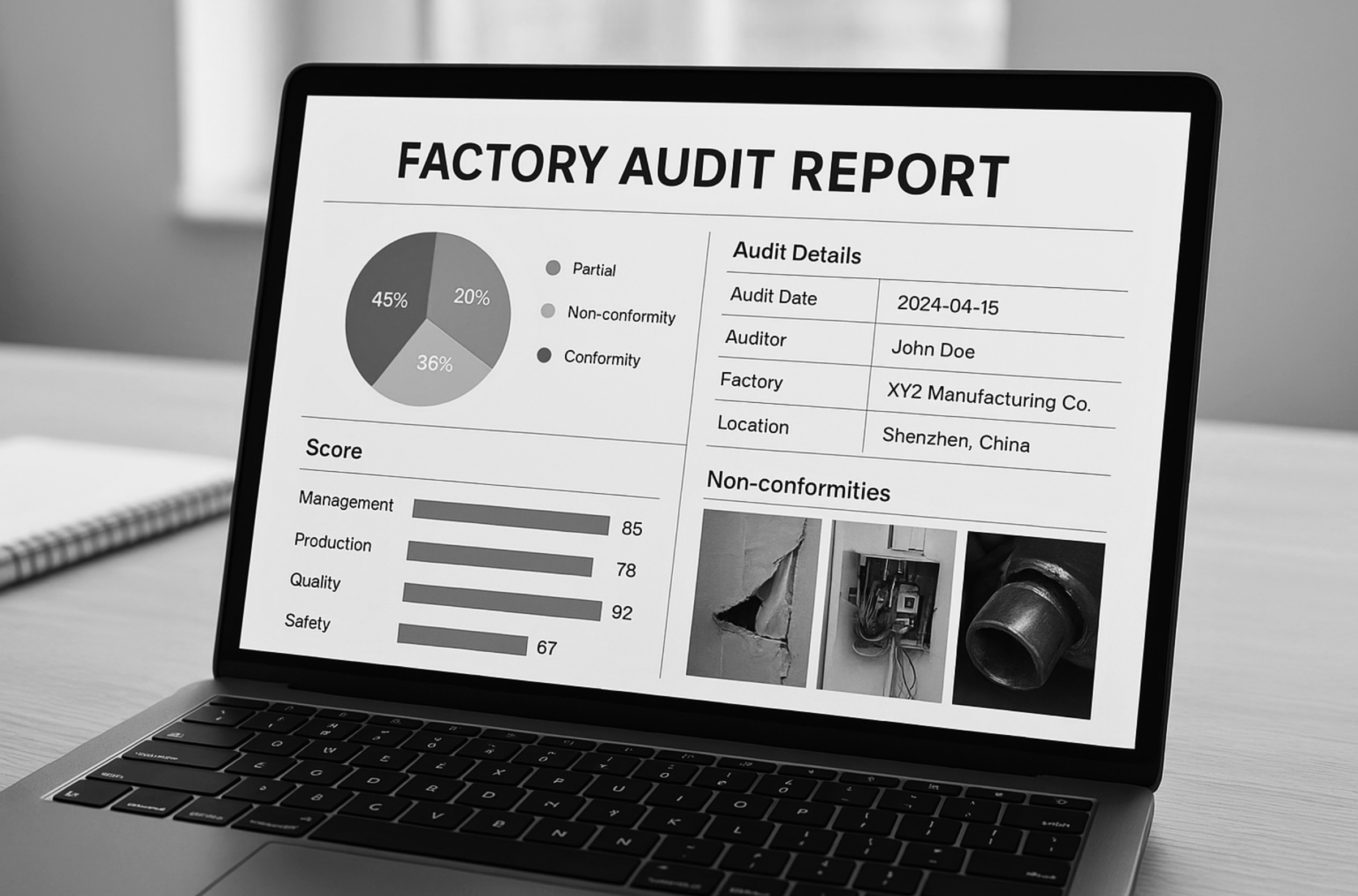
The output of a professional China factory audit is a detailed report, often over 50 pages long, filled with photos, documents, and objective findings. The report will typically score the factory in each area and list any non-conformities, categorized by severity (minor, major, critical).
A key part of the report is the Corrective Action Plan (CAP). For any non-conformities found, the factory is required to propose a plan to fix the issue, with a clear timeline. Your role, or your sourcing partner’s, is to follow up and verify that these corrective actions have been successfully implemented. A factory’s willingness to engage seriously with a CAP is a strong indicator of their commitment to partnership and continuous improvement.
Frequently Asked Questions (FAQ)
- What is the difference between a factory audit and a QC inspection?
A QC inspection is product-focused and asks, “Is this batch of products acceptable?” It’s a snapshot in time. A China factory audit is system-focused and asks, “Is this factory a viable long-term partner?” It assesses the factory’s capabilities, ethics, and stability.
- How much does a professional factory audit cost?
A comprehensive one-day audit from a reputable third-party firm typically costs between $600 and $1,000. While more expensive than a QC check, its role in preventing a disastrous long-term partnership makes the ROI immense.
- What are the biggest “red flags” during a furniture supplier audit?
- Inconsistent answers or a refusal to show certain documents or areas of the factory.
- Evidence of child labor or unsafe working conditions (a critical failure).
- A complete lack of a documented quality management system.
- Claiming to be a factory but having very little machinery, indicating they are likely a trading company or assembly workshop.
Read More from Our In-depth Analysis & Expert Solutions
From Vetting to Partnership: The Foundation of Trust
A professional China factory audit is the ultimate form of due diligence. It is the data-driven process that provides the confidence needed to move forward with a multi-million dollar sourcing program. At ChinaSourcing.co, conducting comprehensive factory audits is a cornerstone of our service. We don’t just find suppliers; we vet them to the highest international standards. We provide our partners with the transparent, in-depth intelligence required to build a supply chain founded not on hope, but on verifiable trust and capability.
Let’s discuss your strategic objectives.
Schedule a confidential, no-obligation Strategic Supply Chain Assessment with our senior partners. We will discuss your specific challenges—whether it’s ensuring supplier compliance, managing a multi-million dollar sourcing budget, or building a scalable and secure platform for your next phase of growth.
Please subscribe to see the detail
Free Resources Right Here
Enter your email to gain full access to our resources
Get exclusive access from expert insights to streamline your supply chain.
Free Resources
Explore More Relative Resources

Example Category
China's March PMI Reaches 50.4 Amid Middle East Conflict Pressures
Stronger Demand Drives China's Manufacturing PMI to 50.4 China's factory activity experienced its highest growth in a year during March, buoyed by st...

28/07/2026

4 min read
![Furniture Wholesale Suppliers: The Ultimate Framework to Vet Top Manufacturers in China [2025]](https://chinasourcing.co/wp-content/uploads/2025/10/10-point-framework-vetting-furniture-wholesale-suppliers.png)
Example Category
Furniture Wholesale Suppliers: The Ultimate Framework to Vet Top Manufacturers in China [2025]
For leaders in the furniture wholesale suppliers industry, a polished Alibaba profile or impressive product brochure are vanity metrics. The true me...
17/06/2026
8 min read

Example Category
The 2026 consumer goods pivot: Why your China strategy needs an upgrade
We have entered a new era for consumer goods in China. The latest "Horizon Scanning" reports for 2026 confirm that the market has moved beyond simpl...
19/03/2026
3 min read
Contact Us Right Today
Ready to work with a sourcing team that’s built for real-world results?
From first quote to final delivery, China Sourcing Co helps you simplify sourcing, reduce risks, and scale with confidence.