



How to Calculate Landed Cost Furniture: An Advanced Guide for Importers
 Tag
TagExample Category
 Date
Date24/06/2026
 Reading Time
8 min read
For leaders of large-scale furniture distribution businesses, the distinction between a profitable import program and a loss-making one often hinges on a single, frequently misunderstood metric: the Total Landed Cost. While many can calculate a basic estimate, few master the granular, forensic approach required to forecast it with the precision demanded by a multi-million dollar operation. Relying on simple FOB-to-retail multipliers is not a strategy; it is a gamble. A 5% miscalculation in your landed cost furniture forecast on a $1 million inventory investment represents a $50,000 direct hit to your bottom line.
This guide provides an advanced framework for furniture costing, moving beyond basic arithmetic to build a strategic financial model. We will dissect every variable, from the complexities of import duty calculation to the often-overlooked “hidden” fees that can erode margins. The objective is not just to provide a formula, but to arm you with a systematic methodology for achieving financial predictability. This is the financial discipline that separates professional importers from amateurs, transforming your pricing strategy from a reactive guess into a data-driven science.
The Strategic Imperative: Why Granular Costing Matters
For a large-scale distributor, a precise landed cost furniture calculation is the central nervous system of your entire business strategy. It is the single source of truth that informs:
- Pricing & Margin Strategy: Your retail and wholesale pricing must be a multiple of your landed cost, not your FOB cost. Without an accurate landed cost, you are flying blind, unable to guarantee profitability on any given product line.
- Cash Flow Forecasting: The landed cost dictates your true working capital requirement. A $500,000 FOB order is, in reality, a ~$750,000 – $800,000 capital outlay. Accurate forecasting is essential for managing cash flow and securing appropriate financing.
- Product Viability Analysis: Not all products are created equal. A bulky, low-value item might seem profitable at the factory gate, but a high landed cost (due to inefficient container loading and high freight costs) could render it commercially unviable. Granular costing allows you to make strategic decisions about which products to pursue.
The Landed Cost Formula: An Advanced Model
The basic formula is simple: Product Cost + Logistics Costs + Compliance Costs = Landed Cost. The complexity lies in accurately forecasting the dozens of variables within each component. We will use a real-world example: A 40ft High Cube container of 500 upholstered armchairs, with an FOB value of $100,000.
Component 1: The Product Cost (FOB Value)
This is your starting point, but it’s not as simple as the price on the invoice.
- FOB (Free On Board) Price: The cost of goods loaded onto the vessel at the port of origin. Our example: $100,000.
- Tooling/Mold Fees: For custom designs, these one-time costs must be amortized across the expected production volume to be accurately reflected in the unit cost.
- Payment Transaction Fees: International wire transfers can cost $50-$100 per transaction. For a 30/70 payment structure, this is a small but real cost.
Subtotal Product Cost: ~$100,100
Component 2: International Logistics & Insurance
This is the most volatile and complex component of furniture costing.
- Ocean Freight: Highly dynamic. Let’s assume a market rate of $4,500 for a 40′ HC to the US West Coast.
- Cargo Insurance: Non-negotiable. The standard formula is (FOB Value + 10%) * Rate (approx 0.5%). So, ($110,000) * 0.005 = $550.
- Origin Charges: These are often overlooked. They include fees for documentation (Bill of Lading), terminal handling (THC), and customs export declaration. Budget ~$500.
Subtotal Logistics Cost: ~$5,550
 Component 3: Customs & Compliance Costs
 Component 3: Customs & Compliance Costs
This is where precise import duty calculation is critical. Errors here can lead to massive fines.
- U.S. Import Duties: This is the most complex variable. It depends on the product’s HS Code and the country of origin. For our upholstered chairs (HS Code 9401.61.4011), the standard duty might be 0%. However, due to current trade policies (e.g., Section 301 tariffs), there may be an additional 25% punitive tariff on goods from China. This is a $25,000 cost that many novice importers miss.
- Merchandise Processing Fee (MPF): A CBP fee calculated as 0.3464% of the FOB value. Capped at a maximum of ~$590. For our order: $100,000 * 0.003464 = $346.40.
- Harbor Maintenance Fee (HMF): A fee of 0.125% of the FOB value, paid on all ocean freight imports. $100,000 * 0.00125 = $125.
- Customs Broker Fees: A professional broker is essential. Their fees for entry filing and managing the process typically range from $300 to $500.
Subtotal Customs & Compliance Cost: ~$25,771
Component 4: Domestic Onshore Logistics (The Final Mile)
These costs are incurred after the container arrives at the destination port.
- Port & Terminal Fees: Includes THC at the destination port. Budget ~$800.
- Inland Trucking (Drayage): The cost to move the container from the port to your warehouse. This can vary dramatically based on distance and fuel costs. A 100-mile trip could be ~$1,200.
- Devanning & Palletizing: The labor cost to unload the container and palletize the goods for warehouse storage. Budget ~$600.
Subtotal Onshore Logistics Cost: ~$2,600
The Final Calculation: Your True Unit Cost
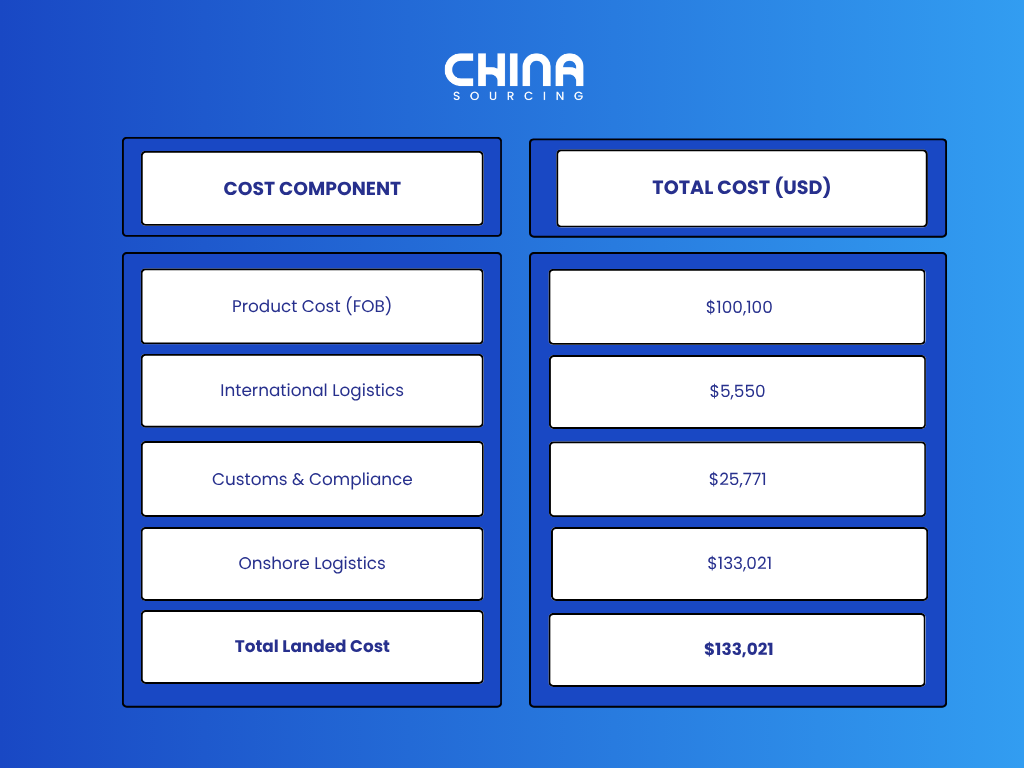
Unit Landed Cost: $133,021 / 500 units = $266.04 per chair.
Strategic Insight: The factory’s FOB price was $200/chair. Your true cost of goods is over 33% higher. Any pricing model, profitability analysis, or financial projection based on the $200 FOB price would have been catastrophically wrong.
Frequently Asked Questions (FAQ)
- How do I find the correct HS Code for my import duty calculation?
The Harmonized Tariff Schedule is a public document available on the U.S. International Trade Commission’s website. However, classification can be complex. Your customs broker is the best resource for ensuring you use the correct HS Code to avoid costly errors and penalties.
- Why is my final freight invoice higher than the quote?
Ocean freight quotes often exclude surcharges like Bunker Adjustment Factor (BAF) for fuel costs or Peak Season Surcharges (PSS). A professional freight forwarder will provide an “all-in” quote, but it’s critical to clarify what is and isn’t included.
- How can I reduce my landed cost?
The biggest levers are negotiating a better FOB price, maximizing container load efficiency (fitting more units into a container to reduce the per-unit freight cost), and structuring your sourcing to legally minimize the impact of punitive tariffs where possible.
Read More from Our In-depth Analysis & Expert Solutions
From Calculation to Competitive Advantage
Mastering the calculation of landed cost furniture is about transforming a complex financial task into a powerful strategic tool. It provides the clarity needed to price with confidence, negotiate effectively, and make intelligent decisions about your product portfolio. At ChinaSourcing.co, we provide our partners with complete financial transparency. We don’t just source products; we provide the detailed, line-item landed cost analysis required to build a predictable and profitable import program.
Let’s discuss your strategic objectives.
Schedule a confidential, no-obligation Strategic Supply Chain Assessment with our senior partners. We will discuss your specific challenges—whether it’s achieving cost transparency, managing a multi-million dollar sourcing budget, or building a scalable and financially sound platform for your next phase of growth.
Please subscribe to see the detail
Free Resources Right Here
Enter your email to gain full access to our resources
Get exclusive access from expert insights to streamline your supply chain.
Free Resources
Explore More Relative Resources
![Furniture Wholesale Suppliers: The Ultimate Framework to Vet Top Manufacturers in China [2025]](https://chinasourcing.co/wp-content/uploads/2025/10/10-point-framework-vetting-furniture-wholesale-suppliers.png)
Example Category
Furniture Wholesale Suppliers: The Ultimate Framework to Vet Top Manufacturers in China [2025]
For leaders in the furniture wholesale suppliers industry, a polished Alibaba profile or impressive product brochure are vanity metrics. The true me...

17/06/2026

8 min read

Example Category
The 2026 consumer goods pivot: Why your China strategy needs an upgrade
We have entered a new era for consumer goods in China. The latest "Horizon Scanning" reports for 2026 confirm that the market has moved beyond simpl...
19/03/2026
3 min read

Example Category
The post-October reality: Why export compliance is the new standard in 2026 China sourcing
We are now several months into the enforcement of China’s sweeping export compliance overhaul. For global procurement leaders, the transition from "...
03/03/2026
3 min read
Contact Us Right Today
Ready to work with a sourcing team that’s built for real-world results?
From first quote to final delivery, China Sourcing Co helps you simplify sourcing, reduce risks, and scale with confidence.