



Strategic Sourcing for School Furniture Wholesale: The Definitive Guide to Safety, Durability, and Long-Term Value
 Tag
TagExample Category
 Date
Date26/07/2026
 Reading Time
11 min read

For educational leaders and procurement managers, sourcing school furniture wholesale is an act of profound responsibility with decade-long consequences. This is not a simple commercial transaction like buying office supplies; it is a direct investment in the safety, health, and learning potential of students. The global educational furniture market, valued at over $12 billion, is filled with options, but the gap between a product that is merely “adequate” and one that is truly safe, durable, and conducive to learning is immense. The right furniture transforms a classroom into a dynamic learning ecosystem; the wrong choice introduces unacceptable safety liabilities, erodes morale, and initiates a costly cycle of premature replacements.
This guide provides a comprehensive strategic framework for sourcing classroom furniture from China. We will move far beyond unit prices to dissect the critical data points that define a successful procurement strategy. This is a deep dive into international safety certifications, the science of material durability, the economics of long-term value, and the methodology for distinguishing a true manufacturing partner from a simple trader. Our goal is to empower you to make fiscally responsible decisions without ever compromising on the well-being of the next generation.

The Non-Negotiable Foundation – A Deep Dive into Safety & Ergonomics
When sourcing school furniture wholesale, safety is not a feature; it is the absolute prerequisite. A single product failure can have catastrophic consequences, exposing an institution to severe legal, financial, and reputational ruin. A robust sourcing strategy must therefore be built upon a foundation of verifiable safety and human-centered design.
Decoding International Safety Mandates
Your vetting process must begin with a rigorous examination of safety compliance. It is not enough for a supplier to claim their products are “safe.” They must provide verifiable, third-party proof. Key international standards include:
- CPSIA (Consumer Product Safety Improvement Act – USA): This is the mandatory standard for any children’s products sold in the United States. It sets strict limits on lead content (under 100 ppm) and phthalates, and requires third-party testing by a CPSC-accepted laboratory. You can learn more at the official U.S. Consumer Product Safety Commission website.
- EN 71 (European Toy Safety Standard): While technically for toys, its stringent tests for chemical properties, flammability, and mechanical safety are often applied to children’s furniture in the EU and are a strong indicator of a supplier’s commitment to safety.
A truly qualified school wholesale supplier will have these reports readily available. Refusal or hesitation to provide them is an immediate disqualification.
Ergonomics as a Learning Tool
Beyond mandated safety, proactive design focuses on creating furniture that supports healthy development and enhances concentration. This is the realm of ergonomics. Static, one-size-fits-all furniture is an outdated concept that can lead to poor posture and distraction.
Modern educational furniture prioritizes adjustability and anthropometric design—the science of fitting products to human body dimensions. For a multi-age school environment, this means sourcing height-adjustable desks and chairs that can be tailored to individual students, ensuring their feet are flat on the floor and their elbows are at a 90-degree angle to the desk. This focus on ergonomics has been shown to improve student engagement and time-on-task.
Proactive Design Safety: Beyond the Certificate
A test report is a snapshot in time; daily safety is embedded in the product’s design. Scrutinize these “micro-features”:
- Edges and Corners: All must be rounded to a safe radius to prevent cuts and impact injuries.
- Anti-Pinch Mechanisms: Any furniture with folding or adjustable parts must have mechanisms that prevent fingers from being trapped.
- Stability Engineering: Desks and especially shelving units must have a low center of gravity and be engineered to resist tipping, even when climbed upon.
- Low-VOC Finishes: All paints and lacquers should be low in Volatile Organic Compounds (VOCs) to ensure healthy indoor air quality, a critical factor for student and teacher health.
The Science of a 10-Year Asset – Material & Construction Forensics
Classroom furniture endures a level of abuse unmatched in any other environment. Material selection must be based on industrial-grade performance.
The Anatomy of a School Desk: Deconstructing Durability
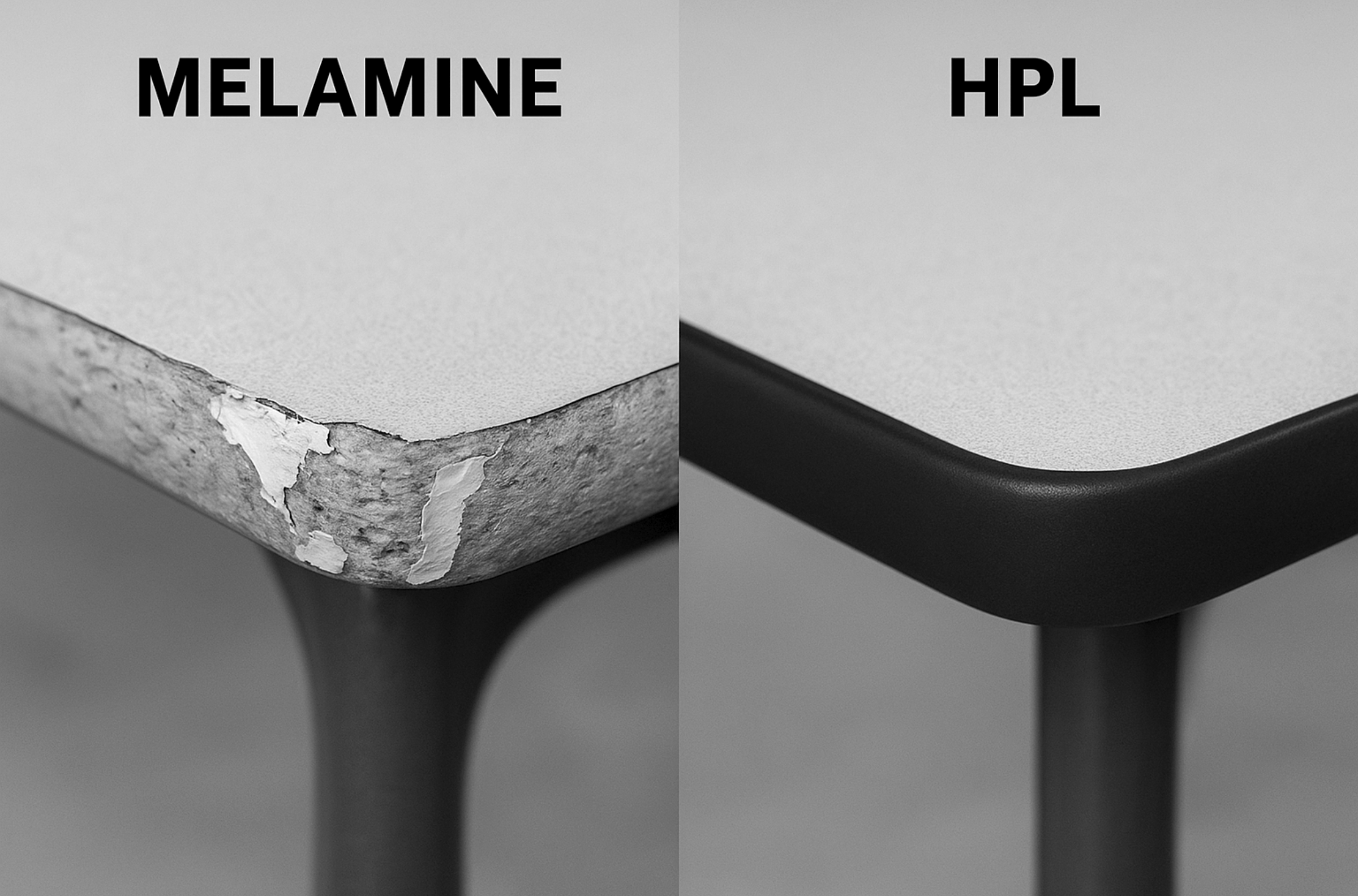
- Tabletops: The surface is the first line of defense. High-Pressure Laminate (HPL) is the superior choice over standard melamine, offering 5-10 times greater resistance to scratching and impact. But the core material is just as important. A high-density particleboard or plywood core provides better screw retention for the legs and greater resistance to moisture-induced swelling than low-density alternatives.
- Edge Banding: The edge is the most common failure point. Look for thick PVC or T-molded edges that are mechanically fixed, not just glued on. These are far more resistant to peeling and vandalism.
- Frames: The gauge of the steel is a key quality indicator; look for 16-gauge (1.5mm) steel or thicker for legs. Equally important is the quality of the welds. Robotic welding provides a stronger, more consistent bond than manual welding.
The Engineering of a Classroom Chair
A classroom chair is a complex piece of engineering. Modern chairs often use a one-piece polypropylene shell, which eliminates joints that can weaken over time. Look for evidence of reinforcement ribbing on the underside for added strength. If choosing a chair with a separate frame, ensure the attachment points are robust, using threaded inserts and bolts rather than simple wood screws.
Beyond the Unit Price – The Economics of Long-Term Value
For budget-constrained institutions, focusing on the initial unit price is a common but costly mistake. The strategic metric is the Total Cost of Ownership (TCO) over the furniture’s expected 10-year lifecycle.
The TCO Calculation Revisited
A cheaper, lower-quality chair that needs to be replaced three times over a decade is far more expensive than a durable chair that lasts the entire period.
Consider this TCO analysis for 100 classroom chairs:
- Chair A (Low-Quality): $25/unit. Lifespan: 3 years.
- Chair B (Commercial-Grade): $45/unit. Lifespan: 10+ years.
Calculation over 10 years:
- Chair A Cost: ($25 x 100) x 3 replacements = $7,500 + labor, disposal costs, and administrative time.
- Chair B Cost: ($45 x 100) x 1 purchase = $4,500.
The “cheaper” chair is ultimately 66% more expensive. A sourcing strategy built on TCO allows for smarter, long-term capital planning.
Future-Proofing Your Investment
The classroom is evolving. The traditional model of rows of desks facing a teacher is being replaced by flexible, collaborative learning spaces. Your furniture procurement strategy must anticipate this shift. Sourcing mobile, modular, and reconfigurable furniture is a “future-proofing” investment. Tables on casters, chairs that stack easily, and desks with unique shapes that can be clustered for group work provide the flexibility to adapt to new teaching methodologies without needing to purchase all-new furniture in five years.
The Supplier Vetting Matrix: Separating Partners from Parts Traders
A top-tier school furniture wholesale supplier provides more than just chairs and desks; they provide project solutions. Use this matrix to assess their true capabilities.
Technical & Quality Systems
- Ask: “Can you provide your ISO 9001 certificate and your internal QC checklist for this product?”
- Look for: A documented, multi-stage QC process (Incoming Quality Control for raw materials, In-Process Quality Control, and Final Quality Control).
Project Management & Capacity
- Ask: “What is your production capacity in containers per month? Can you provide a case study of a multi-container rollout for a school district?”
- Look for: Evidence of experience with large, multi-SKU orders and a dedicated project manager.
Export & Logistics Expertise
- Ask: “How do you package your KD (knocked-down) furniture to ensure easy inventory and distribution on our end?”
- Look for: Clear labeling, frustration-free packaging, and experience shipping to your country.

Frequently Asked Questions (FAQ)
- What is the most important factor when sourcing school furniture wholesale?
Safety is, without question, the most important factor. Verifiable compliance with standards like CPSIA and EN 71, along with inherently safe design features like rounded corners and anti-tip stability, must be the top priority before any discussion of cost.
- What is the most durable and cost-effective material for a student desk?
A tabletop made of High-Pressure Laminate (HPL) on a high-density particleboard or plywood core, combined with a 16-gauge or thicker powder-coated steel frame, offers the best balance of extreme durability, easy maintenance, and long-term value for a high-use classroom environment.
- How can our school district ensure we are getting the best value?
Shift your focus from the initial unit price to the 10-year Total Cost of Ownership (TCO). Investing more upfront in commercial grade educational furniture from a vetted, specialist supplier will result in significant long-term savings by eliminating the need for frequent replacements.
- What is the typical warranty for commercial school furniture, and what should I look for?
A reputable manufacturer of commercial-grade school furniture should offer a warranty of at least 10 years on structural components like frames and shells. Scrutinize the warranty details to understand what is covered (e.g., manufacturing defects vs. normal wear and tear).
Read More from Our Niche-Specific Sourcing Guides
Your Partner in Building Better Learning Environments
Sourcing school furniture wholesale is a mission-critical task of immense complexity. At ChinaSourcing.co, we understand the profound responsibility involved. We act as your dedicated sourcing partner, deploying a rigorous, multi-stage vetting process to connect you only with suppliers who have a proven track record in the educational sector. We verify safety certifications, audit production lines for material integrity, and manage complex logistics, ensuring your investment creates a safe, durable, and inspiring learning environment for the next generation.
Ready to equip your school for success and safety?
Contact Our Sourcing Experts for a Free Consultation Today
Please subscribe to see the detail
Free Resources Right Here
Enter your email to gain full access to our resources
Get exclusive access from expert insights to streamline your supply chain.
Free Resources
Explore More Relative Resources
![Furniture Wholesale Suppliers: The Ultimate Framework to Vet Top Manufacturers in China [2025]](https://chinasourcing.co/wp-content/uploads/2025/10/10-point-framework-vetting-furniture-wholesale-suppliers.png)
Example Category
Furniture Wholesale Suppliers: The Ultimate Framework to Vet Top Manufacturers in China [2025]
For leaders in the furniture wholesale suppliers industry, a polished Alibaba profile or impressive product brochure are vanity metrics. The true me...

17/06/2026

8 min read

Example Category
The 2026 consumer goods pivot: Why your China strategy needs an upgrade
We have entered a new era for consumer goods in China. The latest "Horizon Scanning" reports for 2026 confirm that the market has moved beyond simpl...
19/03/2026
3 min read

Example Category
The post-October reality: Why export compliance is the new standard in 2026 China sourcing
We are now several months into the enforcement of China’s sweeping export compliance overhaul. For global procurement leaders, the transition from "...
03/03/2026
3 min read
Contact Us Right Today
Ready to work with a sourcing team that’s built for real-world results?
From first quote to final delivery, China Sourcing Co helps you simplify sourcing, reduce risks, and scale with confidence.