



What is MOQ in Furniture Sourcing? (+ Proven Negotiation Tips) [2026]
 Tag
TagExample Category
 Date
Date25/08/2026
 Reading Time
9 min read
![What is MOQ in Furniture Sourcing? (+ Proven Negotiation Tips) [2026]](https://chinasourcing.co/wp-content/themes/timberland-main/theme/assets/images/fallback/resource-detail-fallback.png)
Minimum Order Quantity – MOQ in furniture sourcing is one of the most strategically misunderstood concepts in international trade. For furniture importers, a supplier’s MOQ is not just a number; it is a critical barrier to entry, a key negotiation point, and a fundamental variable that dictates your inventory risk, cash flow, and overall business model. Misunderstanding the strategic implications of MOQs is a classic rookie mistake that can lead to over-investing in unproven products or being shut out of partnerships with high-quality factories.
Many new importers view MOQs as an arbitrary hurdle set by inflexible suppliers. This is a strategic misinterpretation. MOQs are not arbitrary; they are a calculated economic necessity for the factory. A factory’s profit margin on a single unit is often razor-thin, sometimes as low as 5-10%. Their profitability is only achieved through the efficiency of mass production.
This expert guide provides a deep-dive analysis into the concept of MOQ specifically for the furniture industry. We will dissect why MOQs exist, analyze the financial risks they impose, and offer professional, actionable strategies for negotiating better terms.

1. Why Do Furniture Suppliers Have MOQs? An Economic Breakdown
Understanding the “why” behind MOQ in furniture sourcing is the first step to becoming a more effective negotiator. A factory’s MOQ is a direct reflection of its break-even point on a production run. It’s the minimum number of units they must produce to cover their fixed and variable costs and achieve a target profit margin.
Key Cost Drivers Behind Furniture MOQs:
- Raw Material Procurement: Factories do not stock vast quantities of every possible material. For a specific order, they must purchase raw materials from their own suppliers, who have their own MOQs. A fabric mill, for example, may not sell less than a 500-meter roll of a specific color. If your chair requires 2 meters of fabric, the factory must order enough fabric for 250 chairs.
- Machine Setup & Tooling Costs (Fixed Costs): Setting up a production line is a labor-intensive process. The cost to set up a CNC machine for a specific wooden component could be $300. If they only make 10 units, that’s a $30 setup cost per unit. If they make 300 units, the cost drops to just $1 per unit. The MOQ is set to amortize this fixed cost over a profitable number of units.
- Labor Efficiency & Opportunity Cost: Production lines operate most efficiently when running continuously. Stopping a line to switch to a very small, different order is inefficient and incurs significant downtime. The factory has an opportunity cost; they could be using that same production slot for a larger, more profitable order.
2. The Financial Impact of High MOQs: A C-Suite Perspective
For a business leader, MOQ is not just an operational number; it’s a critical financial variable that directly impacts the balance sheet. Agreeing to a high MOQ without analyzing the financial consequences can be a catastrophic error.
The Hidden Costs of Excess Inventory
- Holding Costs: This is the most underestimated expense. It’s the cost of storing unsold inventory in your warehouse. Industry benchmarks place annual holding costs at 20-30% of the inventory’s value. This includes warehousing rent, insurance, security, and potential damage or obsolescence.
- Cash Flow & Liquidity Risk: Every dollar tied up in excess inventory is a dollar that cannot be used for marketing, new product development, or other growth initiatives. A high MOQ can severely strain your cash flow. For example, meeting an MOQ of 500 chairs at $50/unit ties up $25,000 of your working capital before you’ve even sold a single item.
Hard vs. Soft MOQs: A Strategic Distinction
Not all MOQs are created equal. Understanding the difference is key to effective negotiation.
- Hard MOQ: This is driven by an external constraint, usually a raw material supplier’s minimum. For example, if a specific type of German-made hardware is only sold in boxes of 1,000, the factory cannot physically produce less than the equivalent number of furniture pieces. These are very difficult to negotiate.
- Soft MOQ: This is set internally by the factory to optimize their production efficiency and profitability. These are the MOQs where skilled negotiation can often yield positive results.
3. What is a “Reasonable” MOQ for Wholesale Furniture?
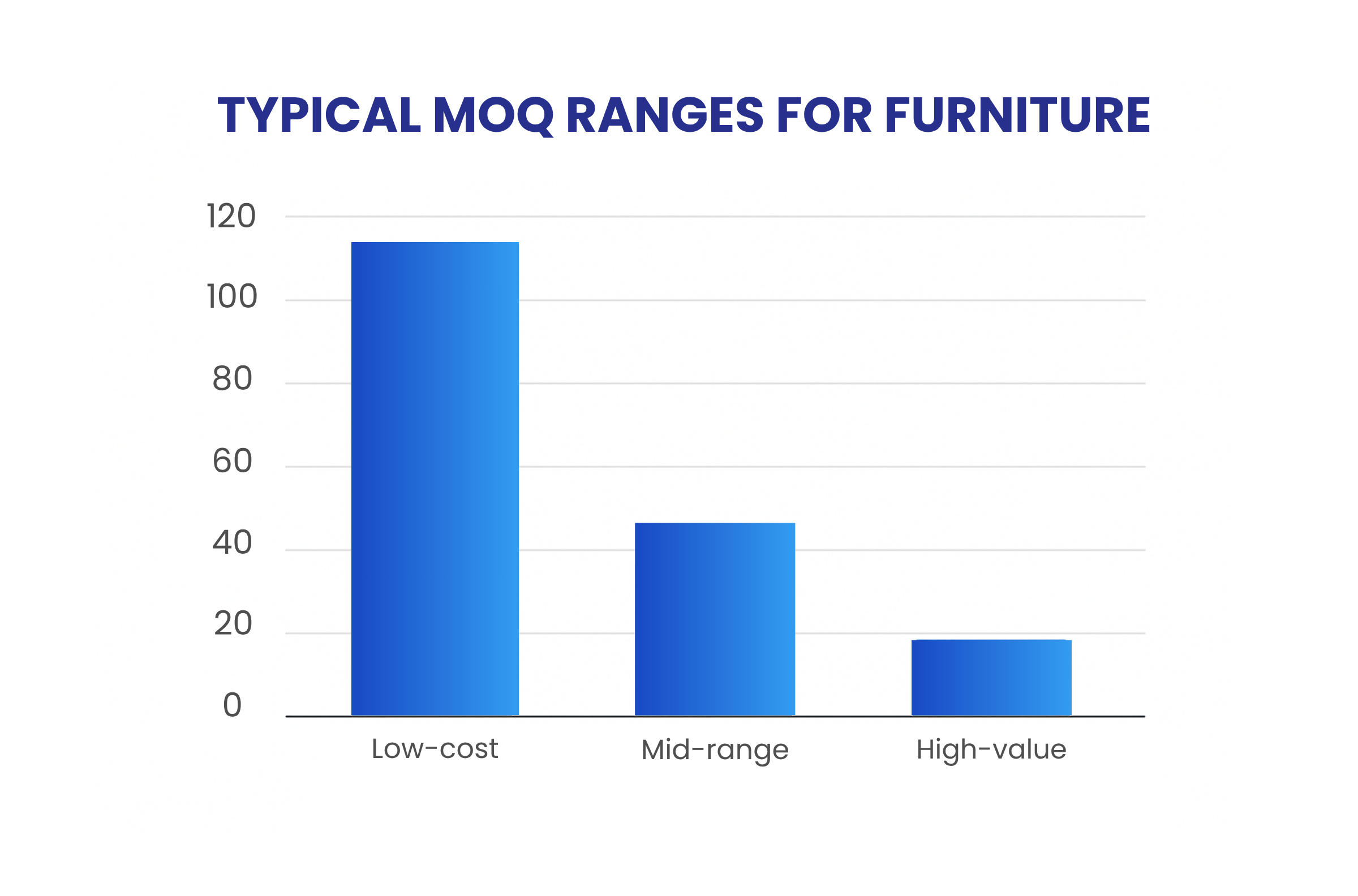
There is no single magic number. It varies dramatically based on the product. However, we can establish some data-driven benchmarks:
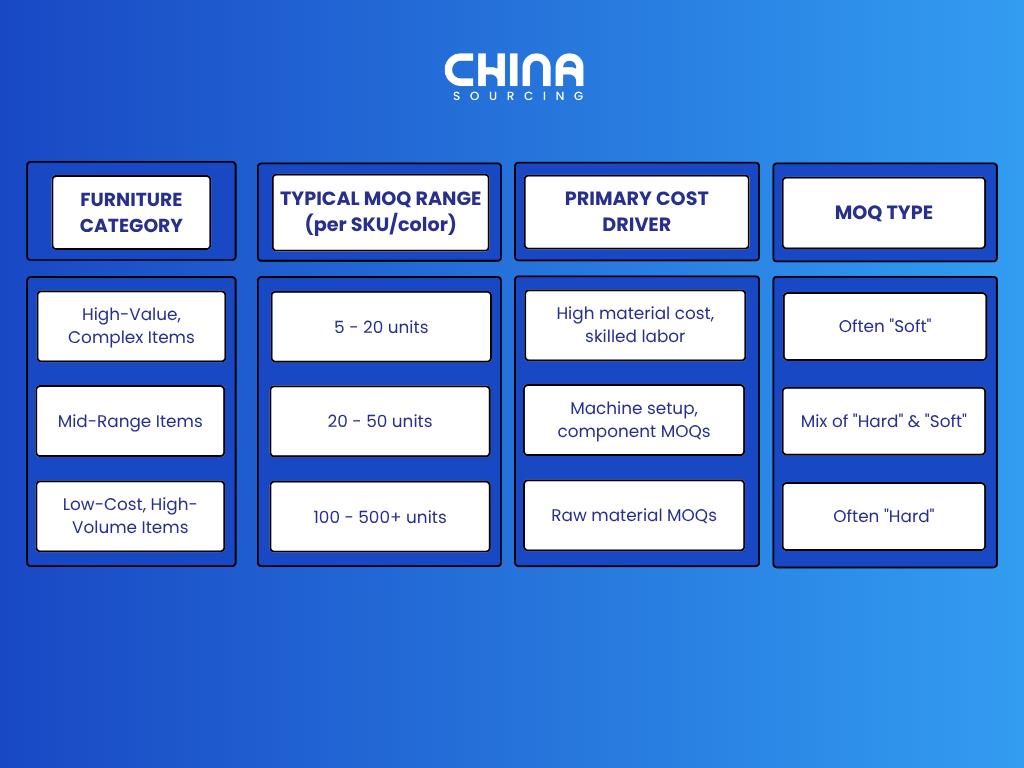
Strategic Insight: If a supplier quotes a high “Hard MOQ” on a product, ask them to identify the specific component driving it. This opens the door to a strategic discussion: “If the MOQ is driven by custom fabric, what would the MOQ be if we used your standard, in-stock black leather?” This is a key part of the process to vet your Chinese furniture suppliers.
4. How to Negotiate MOQs: 5 Professional Strategies
Negotiating MOQs is a delicate art. A strategic approach involves understanding the factory’s cost drivers—especially whether the MOQ is “Hard” or “Soft”—and offering solutions that address their economic realities.

- Consolidate Your Order (Addressing Soft MOQs):
Instead of ordering 20 units of Chair A and 20 of Chair B, ask if you can meet a combined MOQ of 40. This is most effective if the products share common manufacturing processes, allowing the factory to maintain production efficiency.
- Offer to Pay a Higher Price Per Unit (Addressing Soft MOQs):
This is a direct and often successful tactic. If the MOQ is 50 units at $100/unit, but you only want 30, offer to pay $105/unit. The factory might accept, as your higher price helps offset their lower production efficiency.
- Modify the Product (Addressing Hard MOQs):
If the MOQ is driven by a specific imported component, ask for alternatives. Strategic Question: “We understand Italian leather has a high MOQ. What would the MOQ be if we switched to your high-quality domestic leather option?”
- Offer a Deposit for Future Orders:
This builds trust and shows long-term commitment. Example: “We can only commit to 30 units for this first order. However, we are willing to place a 10% deposit for a second order of 50 units to be produced next quarter. Can this allow us to proceed?”
- Time Your Order with a Larger Production Run:
Ask your supplier if they have another large order for a similar product scheduled. Example: “We know you have a large order for the US market shipping in October. Can our smaller 50-unit order be ‘piggybacked’ onto that same production run?”
5. Read More from Our A-Z Sourcing Guide
Understanding MOQs is one piece of the puzzle. To master the entire sourcing process, explore our other expert guides:
6. Beyond Negotiation: The Strategic Advantage of a Sourcing Partner
While these negotiation tactics can be effective, they require a deep understanding of the manufacturing landscape. For most businesses, the most effective way to overcome MOQ barriers is to leverage the collective bargaining power and on-the-ground expertise of a professional sourcing partner.
At ChinaSourcing.co, we have long-standing relationships with hundreds of factories. We understand their production schedules and cost structures. We can quickly identify whether an MOQ is “Hard” or “Soft” and deploy the right negotiation strategy. We transform MOQ from a barrier into a manageable variable, allowing you to source more efficiently and test new products with less risk.
Ready to overcome MOQ barriers and optimize your sourcing strategy?
Please subscribe to see the detail
Free Resources Right Here
Enter your email to gain full access to our resources
Get exclusive access from expert insights to streamline your supply chain.
Free Resources
Explore More Relative Resources
Example Category
China's March PMI Reaches 50.4 Amid Middle East Conflict Pressures
Stronger Demand Drives China's Manufacturing PMI to 50.4 China's factory activity experienced its highest growth in a year during March, buoyed by st...

28/07/2026

4 min read
![Furniture Wholesale Suppliers: The Ultimate Framework to Vet Top Manufacturers in China [2025]](https://chinasourcing.co/wp-content/uploads/2025/10/10-point-framework-vetting-furniture-wholesale-suppliers.png)
Example Category
Furniture Wholesale Suppliers: The Ultimate Framework to Vet Top Manufacturers in China [2025]
For leaders in the furniture wholesale suppliers industry, a polished Alibaba profile or impressive product brochure are vanity metrics. The true me...
17/06/2026
8 min read

Example Category
The 2026 consumer goods pivot: Why your China strategy needs an upgrade
We have entered a new era for consumer goods in China. The latest "Horizon Scanning" reports for 2026 confirm that the market has moved beyond simpl...
19/03/2026
3 min read
Contact Us Right Today
Ready to work with a sourcing team that’s built for real-world results?
From first quote to final delivery, China Sourcing Co helps you simplify sourcing, reduce risks, and scale with confidence.